
Bringing LIVE animals is one way to increase the excitement and engagement of the classroom experience for your students. These jumping beans are something we used to have as kids, and it is fun to bring them back to today’s kids. These jumping beans do take a little time and work to get hatched, but it is rewarding when it works! We do these labs in May and I send the jumping beans home with my students. They have usually hatched by the end of the summer. I also tell me kids they should keep the moths as a PET and not release them into the wild as they are an invasive species.
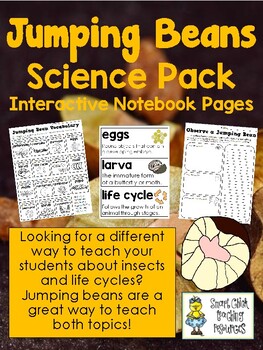
This pack will guide you through a bunch of different lessons as your students learn about insects and jumping beans! Click here to buy the pack!
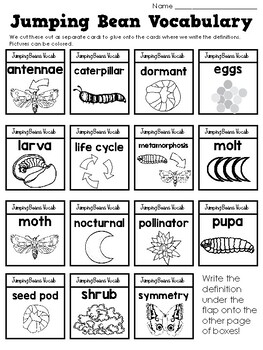
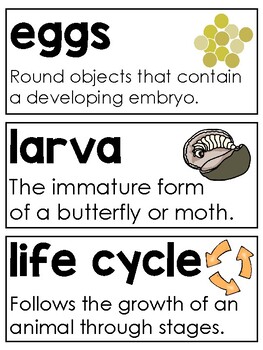
We set-up a bulletin board of the vocabulary words included in the pack.
I order jumping beans from Amazon! They are inexpensive and arrive quickly.
Click here to grab 30 jumping beans from Amazon for around $20!
There are many different activities included in the pack. The kids were AMAZED by the jumping beans and how they moved.
They were able to do a lot of research on-line and we figured out the best ways to keep the larva alive as they are developing into moths.
Storing them in a cool, dry place and spritzing them with water a couple times a week seems to be the best way to get them to hatch!
There are lots of materials included in the pack I developed for my own classroom!
The pack linked above includes:
1. Jumping Bean Vocabulary – There are 15 vocabulary cards with definitions and pictures and an interactive notebook page for recording these definitions.
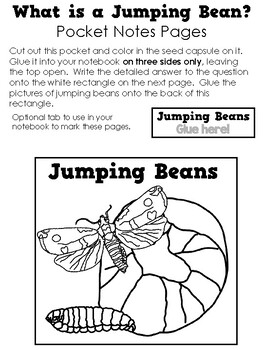
2. What is a Jumping Bean? – There is a pocket for recording the definition of a jumping bean and an information page. We also read the book, Not a Bean, by Claudia Guadalupe Martinez. There is also an Observe a Jumping Bean Lab (we use a real jumping bean for this observation).
3. Life Cycle of a Jumping Bean – There is information about the life cycle of the jumping bean. Students need to create their own life cycle chart for their notebook. Copy the front page on cardstock if possible.
4. Prediction/Recording Sheet – Complete a sheet making some predictions about the jumping beans and record some data about the beans you have in the classroom.
5. Science Lab for Temperature Reaction – Find out how the jumping beans react to different temperatures by completing this lab.
6. Science Lab for Water Reaction – Find out how jumping beans react to water by completing this lab.
7. Science Lab for Touch Reaction – find out how jumping beans react to being help between two fingers by completing this lab.
8. Make a Game Board – Make a game board for the jumping beans to be placed on. Record observations. A completed game board is included on a second sheet of the pack.
9. Fun Facts about Jumping Beans – Do some research using books and/or the Internet. Find 6 fun facts about jumping beans. Make a mini-poster with your findings.
Keep your students engaged at the end of the school year with LIVE animals! There are many to choose from, but my class really enjoys learning about jumping beans!
 Smart Chick Teacher's Blog